Friday, September 15, 2017

Turtuk


It was pitch dark and I was waiting for the last meal of the day at Shayok home stay's DIY gazeebo. LED bulbs at subsidized rates by the Government of India had reached this part of the country as informed by a local. The host was in the kitchen and the essence of the South Asian Spices could assure me that I was in the Indian Subcontinent.

Hiraeth brought me my Tea. No denying the fact that the number of the Thankyous we Indians say while we are traveling, if inculcated in our regular lives, this country will be a different experience to live in. While thanking Hiraeth for the tea, I expressed my curiosity if there was a third person in the kitchen who was disseminating the essence of the saute. It was his wife in the kitchen.

The bridge of the village across
Shayok River. 
Hiraeth was a Government school teacher and used to help his wife in the daily chores in the evening. He had studied English Literature at the Jamia University in Delhi. After having lived in the capital for almost 5 years he shifted back to his home and later got married. His wife who was now expecting their first baby needed more of his involvement in the home stay business. Not known to many travelers till the last decade, they stayed in the Northern most village on the Indian mainland. A few kilometers away is Pakistan. After serving the dinner the couple left for their home which was in the same lane a few properties away.

Pakistan is just a few kilometers away.
I have always been fascinated with Pakistan. after growing up in North India and after having met beautiful and interesting people from Delhi, Himachal, Punjab and of course my homeland Jammu and Kashmir, I have developed an understanding of what the partition of 1947 would  have costed the ones who suffered. Had there been no partition, I would have not been really interested to seek and insight into this country that we call as Pakistan. My grandfather worked in Pakistan before the partition. It was the nature of his job which made him travel extensively. So here I am assuming how the bus journey from Sialkot to Jammu would have been similar to a bus journey from Delhi to Chandigarh today.  But in the current time if I reciprocate the journey from Jammu to Sialkot, I am certain that we will be sighting green flags all around in our imagination. No surprises that most of the Indians would have not even heard of the town Sialkot (which is the manufacturer of maximum bagpipes in the world) in present day Pakistan. Interestingly, I came across an incident when a family member residing in Hyderabad (India) was asked to submit a copy of his Indian passport to parcel some goods from Hyderabad to Jammu. Well, the courier guy was then informed that Jammu is in India. Is ignorance really a bliss?

Conditioned as an Indian so far, I will not deny the fact that I was a little scared that night; dismayed. Maybe the over thinker in me got activated and made me believe that I might be questioned by anyone for not calling myself Siddhiqui. The next moment I woke up to the Aazaan from the nearby mosque and it was right before the dawn. The time when the only active members of any village would be the cattle. Leaving a message for the host next to the Holy Quran on my table I checked out of the accommodation.
Off to school in the valley.

There were no travel agents in the village to book me a ride to the closest town and further cnnecting me to Leh. There was one spot from where some limted cars passed. Waiting at that spot the same morning, I happened to hit an interesting conversation with a young man in his 40s . He pointed towards a peak and remarked it as Pakistan. Well, that close!

Paparazzi!
After the 1971 war between India and Pakistan, This village was one of the very few villages that were undertaken by the Indian Army.
My proximity to the neighboring country took me back to this funny incident when the dating application on my phone last year in Jammu was reaching out and detecting only Pakistani Women. so was I using Tinder across the border, internationally?

At the local taxi stand
The young man in his 40s shared his honest belief that how difficult was it to change from one nationality to another,"Our currencies changed, National Anthem, leaders,Army, All changed "
He informed me that this had lead to a major issue of Identity crisis in the village. Maybe that is the reason why the kids I had met last evening at the local polo ground of the village had their best cricket players comprising of players from both India and Pakistan, The first Indian player they quoted was Kohli after a bunch of their favorite Pakistan players topping their respective lists.


Khardungla was rough unlike this guy who drove me to Leh.
Almost half an hour of a sensible interaction with this man I got into a shared SUV. Sharing the ride with all the locals hailing from the same terrain and heading to Leh. All were students heading to college after spending a good time at home during Eid. On the front seat to me was a young girl clad in black burka. Zainab was a student of Science t the Undergraduate level in the government colllege at Leh.  Accompanied by her brother who was a doctor in Srinagar.

Passing through the barren valleys of the Karakoram range, I was introduced to the recent tracks of Coke Studio Pakistan- season 9. The only lady in the car was requesting when the track was to be changed and what track had to be played next.  3 hours post our start we were ascending towards Khardungla pass when I experienced my first live snowfall. Zainab turned around and asked if she was expected to shut the window, which I didn't want owing to the surreal experience. Khardungla was rough to us. Delayed by the snowfall we reacheD Leh at 10 in the night.


I did not exchange any numbers and e-mail ids with anyone I had met during this ride. I instead wanted to keep it sacred.

Turtuk made me meet some really sweet, honest, pure and safe people till now. (provided one follows some norms made by the Balti clan.)

Norms, Conditions, Requests, Rules, Ideology, Ideals or Hegemony.
Whatever you may want to call it!

https://youtu.be/GMxillp487w


Thursday, January 26, 2017

A day in Diu; Isle of Calm

By now I had developed a fair understanding to decipher the widely spoken dialect of Gujarati in the Indian state of Gujarat. I had also owned a magnetic compass that I traded from an old merchant selling valuables from a ship which was dismantled in Alang back in the beginning of this century. Unpredictable as always, I had a day to spend in this part of India. I was too close to the coast that an overnight journey by road could offer me some valuable exposure to the island of Diu. And, the next moment I was seated in a Gujarat state roadways bus to Somnath via Diu. Next to me were two ladies from the Rabari clan. My portable phone charger was a bit astonishing to them!

3 AM, half asleep and I was woken up by an unbridled gush of the pungent smell of fish. I was passing Jafarabad. 'How about trying some sea food the following morning in Diu?'  but life is not just about writing travel blogs and gastronomic experiences that the vegetarian in me would have persuaded me to have sea food the next morning.


Amidst all you see the Indian flag.  but what does the saffron symbolize here? 
                                              
Soda bottle opener wala; for about two decades Diu was inhabited by Parsis. 
Considering the proximity to Gujarat,  Diu is a blessing  for alcoholics of Gujarat, tiny bars have opened up like grocery stores in any other Indian town.


Panikota, Diu
Fort Diu


For how many times will the cannonballs fly before they are forever banned? Fort Diu


Portuguese or the Mughals, Jaalis; connecting us since the inception.
Setting up of the local market


I think she was a Siddi in Diu.
 Ignorant about the camera.
 For the love for tea


No matter which part of this country, the color has to pop out on the roads.


This is Safar store from where I hired a bicycle . Pedaling across the Isle of Calm. An extremely humble  and a learned  man who runs this store since decades. Not many such cycle stores exist in Diu owing to the growing demand of Motor cycles. I doubt if I would have hired a bike even even if I had been carrying my Driving licence. Cycling for 12 miles after 12 years! A decision resulting to  mixed emotions.

Jalandhar  Beach

Nadia Caves
Travertine, No?


Reminiscence of festa de deu
Bicycle track around the island.

Church of our Lady of Remedes


Bus stand, Diu.
One of the bridges that connects Diu to the Indian mainland.

Reaching the town back at around 4PM, I returned the bicycle to Safar Stores and started back for Delhi. By the end of the day I had spent a brief but a good time with people carrying a lineage from Africa, Portugal, Israel. None of them were tourists, all Indians, settled here in DIU, Well connected to rest of the world, living in a calm on the Ilha de Calma.

Sunday, October 30, 2016

Mosaic tiles through the golden mean

In one of my previous attempts on this blog I had compared the Fibonacci with the Paisley. Last week I was in Gujarat to review the work happening on one of the residential projects that I am handling on behalf of the Delhi based Architectural firm I work with, K2INDIA. It's a renovation project that we are doing where in we are expanding the first residential property designed by Ar.Charles Correa in India. A very interesting and amalgamated play of levels, heights and angles indeed! At one of the levels I was glued to what a woman was busy doing. A very evident contributor to the art of mosaic laying that was started in the age of Mesopotamian civilization, this young woman was collecting little pieces of tiles by breaking big solid pieces of tiles. What interests me is the pattern she was following while breaking. Did someone just brief her on the golden mean??? Don't forget to adore the baby in deep sleep while his mauma is busy contributing to this form of Art ;) 


Thursday, March 24, 2016

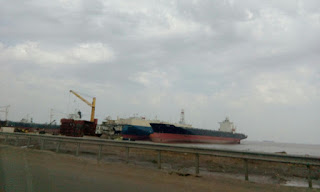
Alang; a porthole onshore.

The permanent stains of oil and grease on my leather shoes is a souvenir I brought back from Alang. My frequent travel to Gujarat in the recent past enlightened me about Alang on the western coast of the Gulf of Khambat. Considered to be one of the world's largest shipyards, Alang recycles half of world's ships.
The swirl of the windmills while approaching the shore, the moisture laden winds and a drizzle followed by a strong sun was all that was essential to make this brief visit drenched in filth and dirt. Dirty in real sense, beautiful in a realistic sense. Apparently, Alang is one such evident example of business tourism in India where one encounters cargo ships, containers, passenger ships, cruises that approach this shore for their final breakdown bringing along people from Korea (of course South), Japan, Europe, South East Asia and locally from all parts of India.
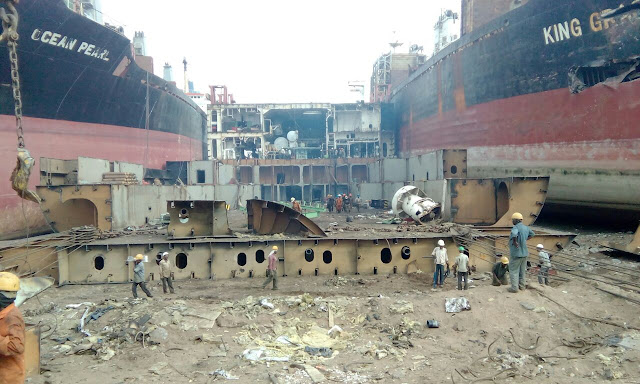
I hence spotted lesser Gujratis in Gujarat. Loads of young men from Bihar and UP are here making this place sound very different to how Gujarat sounds. A sea shore for someone who comes from a landlocked area of India's National capital is typically a beach in Kerala or a shack in Goan waters but this was a third dimension. A shore with Ships of all sizes lined, fumes in the air of continuous welding and burning, moisture of the western coast and noise of course from all the dismantling happening around. One of the workers took me to this cargo which was a live example for me.
As a practicing spatial designer I couldn't stop myself from admiring the fact that the best possible way to see efficient space planning is to get into a ship. And if its a ship getting dismantled, its a blessing indeed! You not only visually observe a sectional elevation of this massive structure being chopped off in parts but you even practically experience it finding yourself standing at one of the levels.
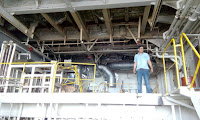
Climbing to the third level from the deck using the technically called 'bulwark ladder', I found myself in some machine room which was not a room. Actually, I was inside the engine which was now half opened! Felt as an anti body inside the engine of an automobile. Like how they show in automobile engine oil animated graphic ads with the gear starts moving at a faster pace when poured the special engine oil.
Further up, there was this part which seemed to be a habitable part of a cargo ship. My attention was grabbed by this plant which was still alive in a ship, breaking of which had started 2 months back.
About the materials and stuff gathered from any ship, there is a different chapter to the story. There are merchants who deal in specific stuff and leftover. So you have one trader who deals only in reclaimed wood and you end up getting good quality wood that has survived at least 20 years in the global ocean waters and then you have series of shops selling machinery that is further purchased by mechanics, industrial design students and small scale industries. From toilet paper to computers, electricals to old paintings, anchors to bunk beds, life jackets to Jack Daniel glass ware. You get everything here for your next startup!
And heres a mere flowchart of how transportation and businesses happen that I had learnt in school books.
This visit was one of those unplanned ones that strengthen my ideology that travel can never be planned. The perception of travel in this age of DSLRs has to be instant. Any location can be beautiful, charming and picturesque. With a time restriction, it was time for me to head North and catch the last flight of the day to Delhi. Taking back home not just the oil stains and soiled denims from Alang, I did managed to trade an age old compass from one of the shops selling antiques which I don't think I am ever going to use pertaining to my 'rolling Stone, no direction home ideology'

Wednesday, October 9, 2013

More uphaars yet to come!

It was back in the late 90s/early 00s that I was on a train with my parents and brother to Jammu. That was the time when I was curious to know why does the second shutter of the window (not the glass one) even exist? The train journey to me was an overnight journey which could happen only via limited trains in my knowledge; Pooja, Shalimar and Jammu mail. I was a mere kid but what I still remember of the journey was an interaction with an old couple on the opposite berth accompanying a little girl. ______________________________________________________________________________Today when I came back home in the evening I surfed through the television channels. Disconcerted, I put on the bollywood movie Border. A chain of thought processes and I am in the train to Jammu. Two years back I did some part time work with a design Studio in green park. Getting off the tube and passing through the service lanes everyday I noticed this huge ruined building with a shady corridor and a rusted structure of a car that was parked there some day. Later on when I got to know that the building I passed everyday was the Uphaar Grand Cinema, I was taken back to this conversation between the old couple and my father that had happened in the train to Jammu. An overnight journey in the train had always fascinated me. How come I get up in the morning and the train is moving in the opposite direction. Yes it did happen and it happens even today, just that today I know the reason! _____________________________________________________________________________ It was that time of the journey when going to bed seems nearly impossible because you find the opposite party is still waiting for the food they ordered from the pantry. The little girl accompanying her grandparents was least interested in food. Addressing to her grandparents as mummy and papa she was wanting to climb to the upper berth. The sad part is that both her parents had passed away in the Uphaar cinema tragedy when she was an infant. I remember her grandfather sharing with my dad that how in the years after the tragedy, the girl had sensed a mummy and a papa in her grandparents. With time she would have got to know about her parents and what took them away from her. ______________________________________________________________________________ All this could have been curtailed if violation hadn't taken place. Today when Restaurants in Hauz Khas Village are shut due to the violation of laws, the youth gets offended and retaliates by saying 'ye kya mazaak hai?' 'government ko kuch kam ni hai kya?' Illegal construction, over use of resources is so prevalent today that the dingy and tightly packed staircases of cafes at Paharganj and Hauz Khas Village seem off stream, cool and inviting, and then we question why did it happen in Kedarnath?

Thursday, August 22, 2013

Fibonacci's Paisley

India has been bestowed with a commendable design history. It is at this point of time when the merging of the two worlds is at the peak. The cultural aspect of the country is slightly on the precarious side but it’s the present that will become the past in the time to come and will thus add to the timeline of India. Be it the planning conceived by the Indus valley civilization or the grandeur of The Mughals or even the time before the 90s, there is something basic that needs to be appreciated. The connections to the other parts of this planet were not very diverse, and life was troublesome as I compare it with the present. It were such conditions which made the individual seek for alternatives, basic yet good ideas to survive. Yes, we have stopped seeking for alternatives in the present time. Paisley- a unique pattern which traces its origin in South Asia (India or Persia) is a pleasing, soothing and a balanced form which has been used extensively in India. The shawls from Kashmir in the north to the Kanchipuram Saris (Indian Drape) in the south, you will find paisley in every wardrobe across the country. Not to forget the heena designs commonly known as mehendi which start with a paisley. I have always been fascinated with the Fibonacci series and have wondered if it was known to the creators of paisley. Yes, I can see the golden curve in paisley.

Tuesday, April 17, 2012

dilli toh sau kilomtetre dur hai.


Its been like 2 and a half months that i visited this place in Rajasthan, about 100 kms from Delhi towards Alwar. 'Neemrana'

I had approached a Design studio based in Delhi for some part time work. It was towards the end of august, 2011 that i fortunately got a chance to report to Sarthak and Sahil Design CO. after my college hours.

A giant chandelier as i was told by my boss. Something that catches hold of your sight as you enter the building. and it does not let you shift your sight for the next 5 minutes.

2nd February 2012. A day before my 21st birthday. The day when the final installation had to take place. Luckily i got to accompany the team to the fort 'NEEMRANA FORT'

A lamp 18 feet high, took almost 8 hours to be hung from the ceiling of the hawa mahal. What interests me the most today is the time spent in the fort during the short breaks we got in the entire process. The fort is under renovation and will soon become a holiday resort. Widely spread on a plateau the fort is currently (as on 2nd february) approached by just load bearing lorries and SUVs.

A shrieking voice of a boy who runs a kitchen would create suspense when he says "dilli toh sau kilometre dur hai" (delhi is approx 100 kms from here). An era when people ensure that their location presents proximity to the capital, this young man says 100kms! Ironically, in and around Delhi, when distances increase people start talking in terms of time.


Approached by the unstoppable winds and the epic love birds you realize how linguistically homogeneous the place was through the love quotes and messages in English Hindi Urdu and a few foreign languages. Extending my view from one of the openings i could see the lush green fields and a hamlet right there surrounding the well constructed house of some higher authority.


Thhandi hawa hai thhandi chhaaon hai
Door woh jaane kiska gaaon hai


The pulley principle followed to hang the lamp reminded me of the Kerala fishing nets but here it was to attain 'a luxury' not 'a need'
By the time it was dark we had completed the task and had to leave for delhi which was 100 kms away. With a common demand of food we stopped at a dhaba and stuffed ourselves with the first meal of the day.

It was around 22:30 and we were about to reach Gurgaon. With high hopes of catching the last metro I managed to board one at around 22:45 probably the last one! Next i had to escape and rush to the elevated platform at kashmiri gate to board the Red Line, and yes i got the last metro. I had traveled in the first metro of the day and the last metro of the same day on the same route and that gave an amazing start to my birthday as i got my first birthday call.